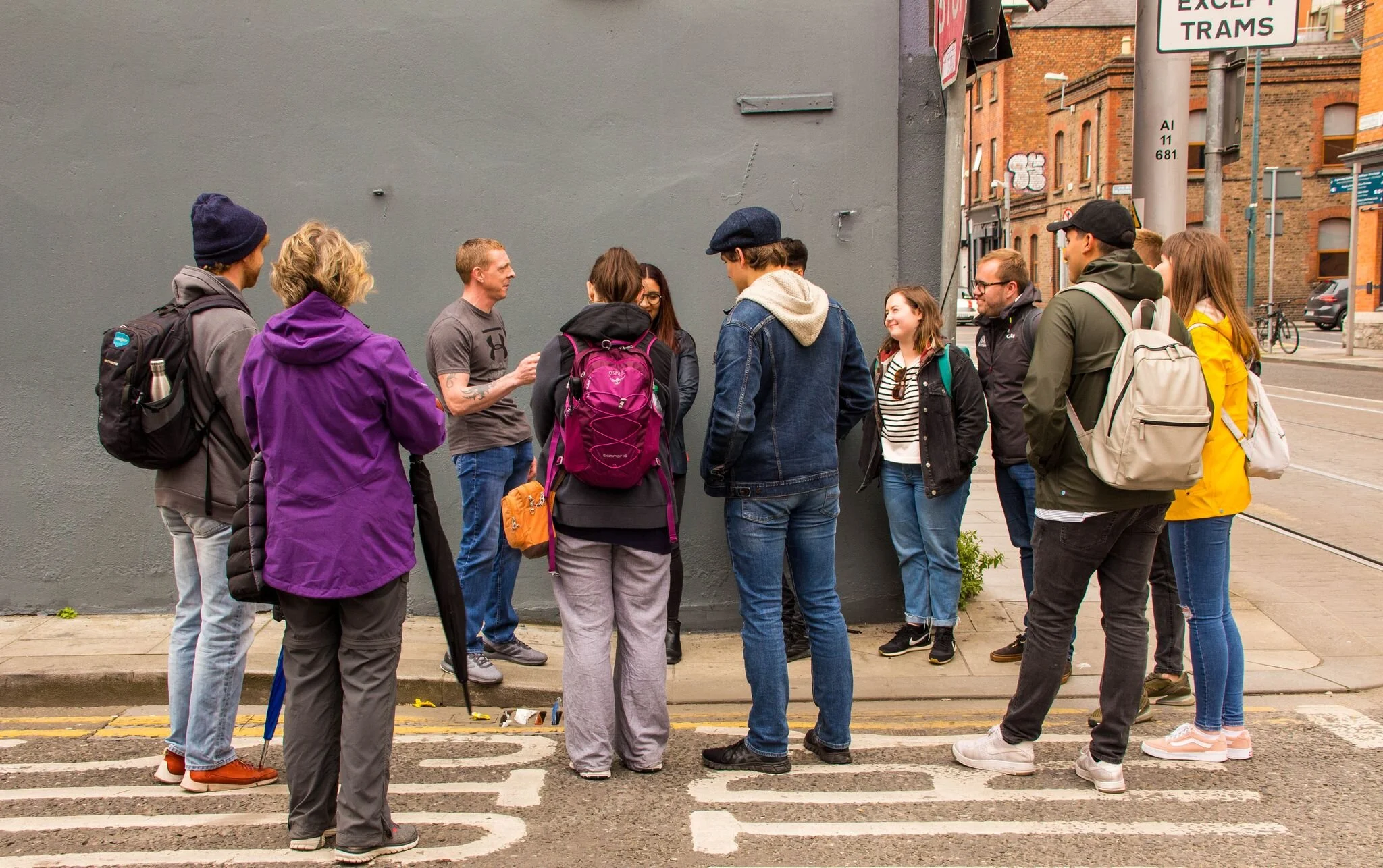
Secret Street Tour
There are many attractions to choose from in Dublin but we suggest starting your adventure with a Secret Street Tour. All of our tour guides have deep connections with the streets of Dublin as they have all experienced homelessness at some point in the past.
Making a Sectret steet tour your first adventure will allow you to experience a unique view of dublin, unseen by many. You will aslo recieved the insight of our experienced guides to set you up for the rest of your stay in Dublin
Our Smithfield Tour takes you on a joruney thourgh the colorful streets of dublin 7. you will begin the walking tour outside Collin’s Barracks. Just up the steps from the Museum Luas Stop. From there, Shane will guide you through the streets, sharing his unique perspective and experiences of homelessness along the way.
We’ll wrap up the tour approximately 1 hour later opposite St. Mary of the Angels. Close by to the Luas and Smithfield square for you to continue your day exploring Dublin.
Our South inner city walking tour begins on Palace Street, right beside Dublin Castle. From there, Ken will guide you through the sometimes narrow and winding city centre streets, sharing his unique perspective and experiences of homelessness along the way.
We’ll wrap up the tour approximately 1 hour later in St. Stephen’s Green, close by the Luas stop (Green Line - St. Stephen’s Green) and Grafton Street for you to continue your day exploring Dublin.
EPIC : The Irish Emigration Museum : Interactive Museum
You won’t find leprechauns or pots of gold here, but you’ll discover that what it means to be Irish expands far beyond the borders of Ireland through the stories of Irish emigrants who became scientists, politicians, poets, artists and even outlaws all over the world. Discover Ireland from the outside in and find out why saying “I’m Irish” is one of the biggest conversation starters, no matter where you are.
The National Botanic Gardens
The National Botanic Gardens of Ireland are an oasis of calm and beauty, and entry is free. A premier scientific institution, the Gardens contain important collections of plant species and cultivars from all over the world. The National Botanic Gardens in Dublin are located in Glasnevin, just three kilometres from Dublin City Centre, and are famous for the exquisitely restored historic glasshouses. The National Botanic Gardens in Wicklow are located in Kilmacurragh, where the milder climate, higher rainfall, and deeper, acidic soils of this historic Wicklow garden, provide a counterpoint to the collections at Glasnevin. The two gardens have been closely associated since 1854. The National Botanic Gardens of Ireland are operated and managed by the Office of Public Works.
Glasnevin Cemetary Museum
The stories of 1.5 million people are faithfully preserved here at Ireland's largest burial place, a beautifully restored Victorian cemetery featuring epic monuments to our past. From poets and presidents, singers and suffragettes, the ordinary and the extraordinary - the stories of those who shaped our nation's history are brought to life.
We are delighted to be open again from September 15th, with our ever-popular Irish History Tour and our brand new indoor visitor experience 'Extra-ordinary Lives'. For the coming months we will be operating a Winter schedule and will be open Wednesday - Sunday inclusive.
We look forward to welcoming you back to Experience Glasnevin – Ireland’s National Cemetery.
Dublin Zoo
Dublin Zoo opened its doors on September 1, 1831. Founded as a private society by anatomists and physicists and supported by wealthy subscribers.
In 1840, featuring 46 mammals and 72 birds donated by London Zoo, the radical decision was to throw its gates open to the public for a penny on Sundays. This gesture, remarkable for that time, established the affectionate relationship that still exists between Dubliners and the ‘ah-Zoo’ in the Phoenix Park.
Now, utterly transformed, Dublin Zoo’s 28 hectares is attracting over 1 million visitors a year. Officially Ireland’s biggest family attraction, not only offers a great day out for all, but also a journey of learning and discovery about the world’s precious wildlife.
General Post Office (GPO) Witness History Museum
The GPO Museum is an immersive, interactive and engaging experience telling the story of the 1916 Easter Rising and Modern Irish History
The GPO Museum is a permanent visitor attraction located within the historic GPO (General Post Office) building on O’Connell Street, Dublin. The experience is one of the newest Dublin Museums and it is one of the top attractions to explore. Free audio guides available in six different languages, subject to availability.
Dublin Writers Museum
The Irish literary tradition is one of the most illustrious in the world, famous for four Nobel Prize winners and for many other writers of international renown. In 1991, the Dublin Writers Museum was opened to house a history and celebration of literary Dublin. It is a view of Irish literature from a Dublin perspective.
The museum is located in a magnificently decorated 18th century mansion in the North City Centre, next to the Garden of Remembrance. The collection features the lives and works of Dublin's literary celebrities over the past three hundred years. Swift and Sheridan, Shaw and Wilde, Yeats, Joyce and Beckett are among those presented through their books, letters, portraits and personal items.
Dublinia - The Heart of Viking and Medevil Dublin : (Viking Museum)
If you are ooking for things to do in Dublin, look no further than Dublinia, at the heart of Viking and Medieval Dublin. Travel back to Viking and Medieval times at Dublinia, in the heart of the old city at Christchurch.
Walk where Vikings walked before. Travel back to the city in Viking Times See what life was like onboard a Viking warship, see the weaponry and learn the skills of being a Viking warrior. Try on Viking clothes, become a slave and stroll down a noisy street. Visit a smoky and cramped Viking house and learn about the myths and mysteries surrounding the Vikings and their legacy.
The National Leprechaun Museum
Folklore made fun, an oral storytelling experience taking you on a trip to the Otherworld, home of leprechauns and other mythical creatures.
In the heart of Dublin, somewhere between bars and buskers, not far off the tram, there is a small place of fun and magic. Take a break from your serious self and step into the Otherworld.
Come on a voyage back to your childhood, bring back the memories and immerse yourself in a world ofmyth and legend.
We Irish are well known for our captivating storytelling. Filled with your imagination and guided by our Storytellers, you'll go on a fantastic adventure. Explore the spaces, listen to the stories and learn about mythical Ireland. We dare you to have fun!
The Jeanie Johnston: An Irish Famine Museum
The original Jeanie Johnston was built in Quebec in Canada in 1847 by Scottish-born shipbuilder and master craftsman, John Munn. It was purchased by Kerry-based merchants, John Donovan and Sons. Originally intended as a cargo ship, she ended up carrying a very different kind of cargo – desperate men, women and children fleeing the Famine. She carried emigrants out to Canada and brought timber back.
She made her maiden voyage from Blennerville, Co. Kerry to Quebec, Canada in 1848 with 193 passengers on board. She transported 2,500 Irish emigrants on 16 transatlantic voyages to North America.
Dublin Wax Museum
The National Wax Museum as it was originally known was initially situated in Granby Row near Parnell Square in Dublin 1. It was opened in 1983 by the Lord Mayor of Dublin and was an exciting new addition to the city. The museum became a landmark with the Giant Cú Chulainn scaling the side of the building and many of our current visitors still remember the infamous tunnels and visiting on there school tour as children. It was then as it is now one of the most famous Dublin Museums.